Wordle works because it reduces language to a perfect deduction game: six guesses, color-coded feedback, one word shared by everyone in the world on the same day. Its genius lies in the constraint — five letters, a vocabulary just broad enough to surprise you, and a loop where every wrong guess is still useful information.
When people search for games like Wordle, they are really after one or more of three things: the word-knowledge challenge, the logical deduction-and-elimination loop, or the communal once-a-day ritual that makes it feel like a shared event. The best alternatives deliver at least two of those three.
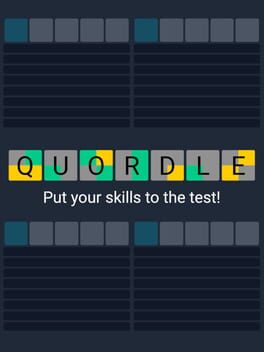
Top pick:Quordle is the single closest pick — it is literally four simultaneous Wordle boards using the identical mechanic, raising the strategy ceiling while keeping everything that makes the original satisfying, and it even follows the same daily shared-puzzle ritual.
Some store buttons are affiliate links — we may earn a commission at no extra cost to you.
18 games like Wordle
95%
Quordle 2022
Quordle asks players to solve four Wordle puzzles simultaneously with the same nine guesses, directly extending the core letter-deduction mechanic. Every guess applies to all four boards at once, massively raising the strategic depth.
Key difference: Four simultaneous boards instead of one.
Best for: Wordle veterans who find the original too easy now.
Skip if: You find one board already challenging enough.
Categories is a daily word-sorting puzzle where players must assign words to the right groups, sharing Wordle's one-puzzle-a-day rhythm and the same satisfying moment of cracking a tricky pattern. It tests vocabulary and lateral thinking in short sessions.
Nerdle replaces the hidden word with a hidden math equation, using the same six-guess color-feedback system as Wordle exactly. Players deduce which numbers and operators occupy which positions through elimination.
Key difference: Math equations instead of English words.
Best for: Wordle fans who prefer numbers and arithmetic over vocabulary.
Skip if: You want language and spelling, not arithmetic operators.
Word Grid challenges players to find words within a grid of letters under a daily format, echoing Wordle's bite-sized word-puzzle structure. Both reward vocabulary knowledge and pattern recognition over reflexes.
Key difference: Spatial grid navigation instead of linear guess-and-eliminate.
Best for: Wordle fans who enjoy crossword-style spatial word hunting.
Skip if: You dislike timed or open-ended word-search formats.
Proximity asks players to guess a secret word and ranks each guess by semantic or alphabetical closeness, giving deductive feedback similar to Wordle's color system. The elimination-by-information loop is almost identical.
Key difference: Feedback is proximity ranking, not exact letter placement.
Best for: Semantle-style fans who want warm/cold word deduction.
Skip if: You need clear green/yellow/gray letter feedback each guess.
Semantle uses word-embedding AI to score each guess by semantic similarity to the hidden word rather than letter position, creating an entirely different kind of linguistic deduction. Players can take unlimited guesses but the cognitive challenge is severe.
Linxicon challenges players to navigate a chain of word associations in a daily puzzle, sharing Wordle's single-daily-challenge structure and vocabulary-forward design. Each move narrows the solution space through language logic.
Key difference: Word-chain association replaces letter-position guessing.
Best for: Players who love word relationships and semantic thinking.
Skip if: You prefer spelling and letter-placement mechanics.
Flipple is a daily word puzzle with a letter-flipping deduction mechanic that sits squarely in Wordle's niche of short, shareable, one-attempt-per-day word challenges. The feedback loop rewards logical process of elimination.
Key difference: Letter transformation mechanic instead of static guess comparison.
Best for: Wordle daily-habit fans seeking a fresh twist on the formula.
Skip if: You want the classic static five-letter guess format exactly.
Bracket City wraps trivia and word reasoning into a daily bracket-style puzzle, sharing Wordle's educational bite-sized format and once-a-day communal play. Players work through elimination rounds using general knowledge.
Key difference: Trivia elimination bracket rather than spelling deduction.
Best for: Quiz fans who want daily word-adjacent trivia challenges.
Skip if: You want pure vocabulary or spelling mechanics, not trivia.
Wordscapes is a crossword-style mobile word game where players form words from a set of letters to fill a grid, sharing Wordle's vocabulary-first design and short-session accessibility. It rewards lateral letter thinking.
Key difference: Ongoing level progression, not a single daily communal guess.
Best for: Wordle fans wanting more puzzles per day on mobile.
Skip if: You specifically want the one-shared-puzzle social ritual.
Mobile
68%
Bookworm 2003
Bookworm challenges players to build words from a grid of letter tiles, tying vocabulary skill directly to score in a way that echoes Wordle's word-knowledge demands. Both games reward players who know uncommon English words.
Best for: Word game veterans who want something with more depth and replayability.
Skip if: You want deduction logic and feedback, not tile-chain mechanics.
PCMobileXboxNintendo
65%💎 Gem
Whirly Word 2011
Whirly Word scrambles a set of letters and asks players to form as many words as possible, sharing Wordle's core appeal of vocabulary knowledge and letter-set manipulation. Sessions are similarly short and satisfying.
Key difference: Open anagram mode with no single target word to guess.
Best for: Fans who enjoy the letter-juggling aspect of Wordle most.
Skip if: You want a hidden target word and elimination-based deduction.
Mobile
63%💎 Gem
Word Charm 2017
Word Charm is a swipe-based word puzzle game where players connect letters to find hidden words, sharing Wordle's educational vocabulary focus and casual pick-up-and-play feel. Both are comfortable short-session games.
Key difference: Swipe-connection mechanic on a letter web, not guessing rows.
Best for: Mobile players wanting relaxed word discovery without pressure.
Skip if: You need competitive daily rankings and a single secret word.
Mobile
58%
Brain Age: Train Your Brain in Minutes a Day! 2005
Brain Age includes word, language, and logic mini-games designed for short daily sessions, mirroring Wordle's ethos of a brief mental workout each day. Its educational Non-fiction framing and vocabulary exercises feel familiar.
Key difference: Broad cognitive mini-game suite, not purely a word puzzle.
Best for: Players who want a daily mental warm-up beyond just word games.
Skip if: You want a single focused word-guessing challenge each day.
Nintendo
52%💎 Gem
What Would You Choose? Rather 2017
What Would You Choose? Rather is a quiz/trivia format that shares Wordle's educational casual structure and the satisfaction of a right answer. Both are short, thinking-based games built for quick daily engagement.
Key difference: Opinion/trivia format with no vocabulary or letter component.
Best for: Trivia fans who like Wordle's bite-sized daily game ritual.
Skip if: You want language and spelling at the core of the puzzle.
2048 is a single-screen daily-friendly logic puzzle where players merge numbered tiles by deduction and elimination, echoing Wordle's clean one-mechanic loop and the satisfaction of cracking a puzzle through pure reasoning.
Key difference: Number-merging spatial grid instead of any word or language mechanic.
Best for: Wordle fans who also enjoy number logic and pattern puzzles.
Skip if: You want vocabulary and language at the center of every puzzle.
Papers, Please is a logic-deduction puzzle game where players analyze documents and apply learned rules to identify correct answers, sharing Wordle's core loop of gathering information each round to narrow toward a solution.
Key difference: Full narrative game with political stakes, not a word puzzle.
Best for: Players who love Wordle's deduction loop and want a story around it.
Skip if: You want quick word puzzles without complex mechanics or narrative.
Her Story has players type keywords into a search interface to uncover a story, making vocabulary and word choice the direct input mechanic in a way no other game does — a spiritual cousin to Wordle's word-focus.
Key difference: Full mystery narrative driven by keyword search, not guessing rows.
Best for: Word-minded players who want language as the core interaction.
Skip if: You want a tidy puzzle with clear win/lose states per session.
Open anagram mode with no single target word to guess.
Mobile
Word Charm
63%
Puzzle
Swipe-connection mechanic on a letter web, not guessing rows.
Mobile
Brain Age: Train Your Brain in Minutes a Day!
58%
Puzzle, Quiz/Trivia
Broad cognitive mini-game suite, not purely a word puzzle.
Nintendo
What Would You Choose? Rather
52%
Quiz/Trivia, Educational
Opinion/trivia format with no vocabulary or letter component.
Mobile, PC
What makes a game feel like Wordle?
Wordle's core is a constrained deduction loop with language as the subject matter: you receive binary-coded feedback (right letter, right place; right letter, wrong place; letter absent) and must narrow your hypothesis space within a fixed number of attempts. Games that replicate this feel best when they share all three elements — a single hidden target, feedback that is useful but not complete, and a hard turn limit.
Proximity and Linxicon from this list are the closest in structure, swapping exact letter-position feedback for closeness scoring or word-chain logic, while preserving the core loop of using each guess as information rather than a random shot.
Best daily-ritual alternatives to Wordle
The daily communal aspect — one puzzle, played at the same time by millions, results shared as emoji grids — is part of Wordle's identity. NYT Connections and NYT Spelling Bee (both in the additional list) replicate this precisely, being produced by the same publisher on the same daily schedule. From the candidate list, Categories and Bracket City also use a once-per-day format designed for sharing results with friends.
If you want something slightly further afield, Brain Age pioneered the idea of a short daily cognitive session long before Wordle — though it lacks the social sharing hook, it nails the habit-forming daily-puzzle ritual.
If you want deduction without words
Wordle's letter-feedback mechanic is structurally identical to the classic board game Mastermind — if you enjoy the logical elimination aspect more than the vocabulary aspect, Nerdle transplants it into arithmetic equations perfectly. From the candidate pool, 2048 scratches the same itch of sitting down for five minutes of pure clean logic and arriving at a satisfying solution through systematic elimination, even though it uses numbers in a grid rather than letters.
Papers, Please is a more ambitious choice: every document check is a deduction round where you apply rules to narrow toward a correct answer, and the feedback loop — stamp approved or denied, see consequences — mirrors the satisfying click of a green tile.
What is the closest game to Wordle for word lovers?
Quordle is the closest structural match — four simultaneous Wordle boards, same mechanic, same daily format. Among purely vocabulary-forward alternatives, NYT Spelling Bee and NYT Connections share Wordle's word-knowledge demands and daily communal ritual.
Are there games like Wordle for math fans?
Yes — Nerdle replaces the hidden five-letter word with a hidden math equation and uses the exact same six-guess color-feedback system. Each guess must itself be a valid equation, so the challenge is simultaneously arithmetic and deductive.
Is there a Wordle game with more than one puzzle per day?
Wordscapes offers unlimited word puzzles in a crossword-style format, so you are never waiting for a daily reset. Quordle technically gives you four puzzles in one sitting. Whirly Word and Word Charm are also effectively unlimited.
What Wordle alternatives can I play with friends or share results?
The daily-format games are best for sharing: NYT Connections, NYT Spelling Bee, Quordle, and Wordle itself all produce shareable emoji grids. Categories and Bracket City from the candidate list also use a daily shared-puzzle model built for social comparison.
Is Wordle good for improving vocabulary?
Research and player reports both suggest Wordle builds awareness of letter patterns, common English roots, and obscure five-letter words over time. Brain Age was explicitly designed for cognitive training including language, and Bookworm and Wordscapes also reinforce vocabulary through gameplay, making them similarly educational alternatives.
 95%
95%